


Pet households are reshaping flooring performance, store displays and category growth – April 2026
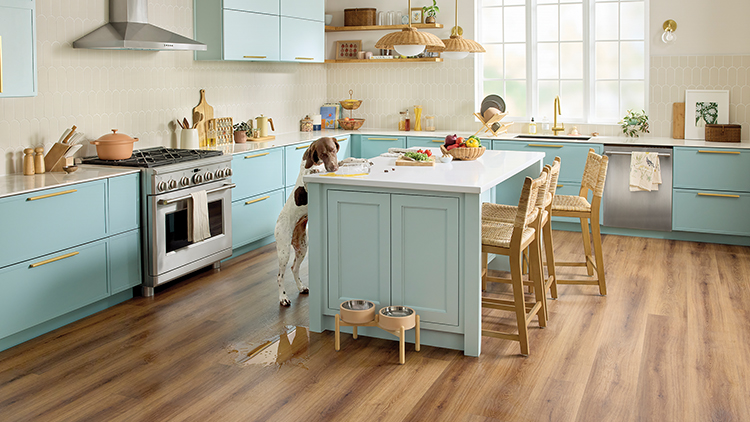
Briard SPC by Shaw Flooring is a waterproof product featuring PawDefense scratch-resistant technology.
By Meg Scarbrough
Pets have long influenced flooring decisions in subtle ways—scratches on hardwood, stains on carpet, muddy paw prints tracked across entryways. Today, however, their impact is far more profound. As pet ownership reaches historic levels and animals become fully integrated members of the household, retailers and manufacturers alike are rethinking how flooring is designed, positioned and sold.
According to the American Pet Products Association’s latest National Pet Owners Survey, roughly 94 million U.S. households—about 71%—now own at least one pet, up significantly from approximately 82 million just two years earlier. Pet industry spending reached an estimated $152 billion in 2024, reflecting not only population growth among companion animals but also a deeper emotional and financial investment in how pets live within the home. Younger demographics are accelerating the trend, with Gen Z accounting for a growing share of new pet adoption and multi-pet households becoming more common across income levels.
For flooring retailers, these shifts are transforming the sales conversation. Performance is no longer defined primarily by technical specifications or long-term wear cycles. Instead, shoppers are increasingly evaluating how flooring will function in the everyday realities of life with pets—from spills and scratches to comfort, safety and ease of maintenance. Across product categories, manufacturers say this lifestyle-driven mindset is influencing everything from innovation pipelines to merchandising strategies, ushering in a new era of pet-centric performance.
PERFORMANCE REIMAGINED
Across the industry, executives point to a clear evolution in how consumers define flooring performance in pet households. While durability remains essential, homeowners are placing greater emphasis on how flooring supports daily routines.
According to Danielle Jensen, director of residential marketing for Mannington Mills, “When it comes to performance, consumers are thinking less about long lists of technical attributes and more about how well a floor supports everyday life with their furry family members,” she explains. “It’s about how flooring handles dirty paws, spills, scratches and constant movement, while still delivering the home decor style they chose. A high-performing floor today is one that lets homeowners relax and enjoy their space without worrying about damage or maintenance.”
Eric Ruppert, vice president of soft surface product development and marketing at Engineered Floors, frames the shift in broader conceptual terms. “Historically, ‘performance’ meant a floor wouldn’t fall apart,” he says. “Today, consumers define it as ‘active peace of mind.’ It is no longer just about the floor surviving the pet; it’s about the floor making life with a pet easier.”
That redefinition has important implications for how flooring is positioned at retail. Amy Tucker, director of hard surfaces for The Dixie Group, says conversations on the sales floor are increasingly anchored in lifestyle scenarios rather than construction details.
“Consumers are no longer buying on specs alone—they define performance by how a floor handles real life with pets,” she notes.
The evolving definition of performance also reflects broader changes in household dynamics. As pets gain unrestricted access to more areas of the home, flooring must accommodate continuous movement between indoor and outdoor environments, increased cleaning frequency and shifting activity patterns throughout the day.
INNOVATION FUELED BY THE PET ECONOMY
The surge in pet ownership has accelerated product innovation across flooring categories, particularly in waterproofing, scratch resistance and stain protection. Manufacturers say demand from pet households has pushed performance technologies from niche differentiators to baseline expectations.
Jensen notes that sustained growth in pet ownership has helped drive the development of more resilient constructions and finishes. “Pet households have been a powerful driver of innovation in flooring,” she says. “The demands of living with pets have helped push the industry toward solutions that support real-life conditions while maintaining design appeal.”
At Shaw Floors, director of marketing Natalie Jones points to targeted product development efforts tied directly to pet-related needs. “The growth in pet ownership, now reaching [most] U.S. households, has significantly influenced innovation across the flooring industry,” she says.
“For Shaw Floors, that shift has helped drive innovations across our Pet Perfect collections, which now span carpet, luxury vinyl and laminate,” Jones notes.
She adds that technologies such as spill-proof backings and enhanced scratch-resistant surfaces are designed to address everyday concerns around accidents and wear, enabling homeowners to balance aesthetic preferences with practical performance requirements.
Similarly, Mohawk has expanded its all-pet protection technologies across multiple product lines in an effort to simplify consumer decision-making.
“We want to design products that just go to work for your pets,” says Justin Hicks, senior director of marketing for wood and laminate at Mohawk.
From the soft surface perspective, Denise Silbert, vice president of marketing for Mohawk’s carpet division, says the company has broadened its performance offerings to reach a wider spectrum of pet-owning consumers.
“We launched Pet Premier in 2023,” she explains. “We added another tier within our product lines to participate more fully in the polyester market with pet-friendly products.”
Engineered Floors has taken a similarly targeted approach, developing technologies engineered specifically to address both mechanical and chemical stressors associated with pet ownership.
“Technologies like PawPrint Protection weren’t just added features; they were engineered from the ground up to address the specific mechanical stress of pet claws and the chemical stress of pet messes,” Ruppert says.
As innovation continues across categories, manufacturers emphasize that the goal is not simply to improve resistance to damage but to enhance the overall ownership experience—reducing maintenance demands, extending product longevity and enabling more flexible design choices within pet-centric households.
HARDWOOD’S PERFORMANCE REPOSITIONING
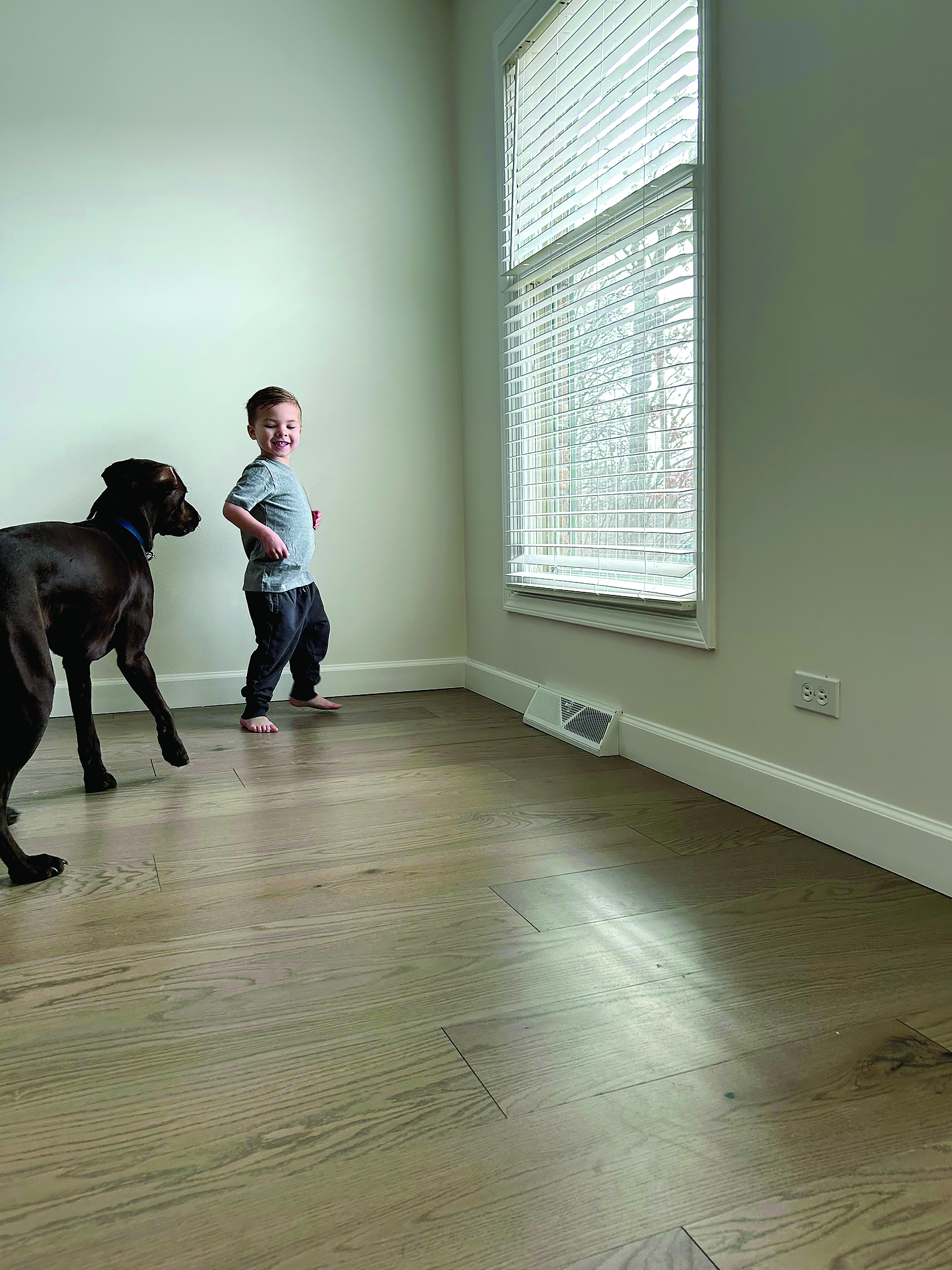
While resilient and laminate products have dominated much of the pet-performance conversation in recent years, hardwood manufacturers are working to reframe the category’s value proposition for pet-owning consumers.
Catherine Del Vecchio, vice president of marketing for AHF Products, says recent advancements in finishing technologies are helping reposition hardwood as a viable option in pet households.
“Pets have always been part of the flooring conversation, but today they are a central design driver,” she explains. “We’re seeing homeowners who once assumed hardwood wasn’t practical with pets reconsider the category because of improvements in scratch resistance, cleanability and long-term performance.”
Del Vecchio notes that pet ownership can influence purchasing psychology in ways that favor higher-quality materials.
“Pet owners are already investing heavily in their animals’ wellbeing,” she says. “That emotional investment often translates into a willingness to upgrade flooring if they believe the product will deliver both durability and design value.”
She also emphasizes the importance of credibility in pet-focused merchandising strategies.
“Retailers say pet-friendly messaging is extremely effective—but only when it’s backed by measurable performance claims,” Del Vecchio adds. “Emotional appeal gets shoppers interested; technical credibility closes the sale.”
This perspective reflects a broader category tension as manufacturers balance performance innovation with the enduring appeal of natural materials. While some consumers continue to gravitate toward resilient constructions for perceived practicality, others are reassessing hardwood as part of a long-term investment strategy that aligns with evolving lifestyle expectations.
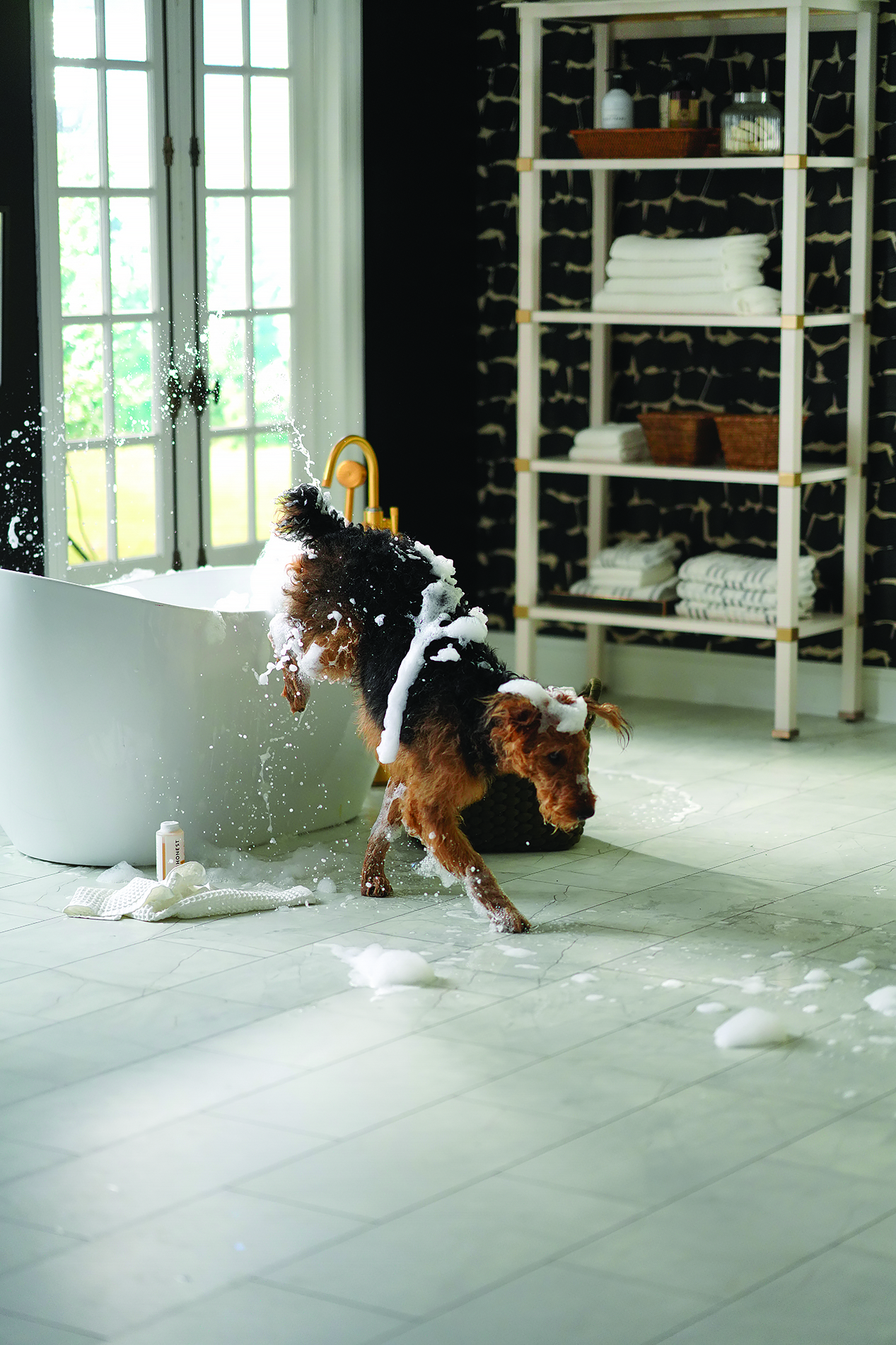
FROM PET-PROOF TO PET-FRIENDLY
As innovation expands, marketing strategies are evolving in parallel. Across brands, executives say messaging has shifted from emphasizing resistance to damage toward acknowledging the broader role pets play in household life.
Tami Stahl, vice president of marketing for The Dixie Group, describes this transition as part of a wider cultural shift toward pet humanization.
“Pet owners are actively upgrading their homes to accommodate pets as family members, not just buying pet products,” she says. “Shifting marketing to making it a pet home instead of ‘pet-proof’ embraces the pet as a family member, not an accessory.”
Tarkett Home echoes that sentiment, emphasizing the importance of connecting product features to real-life scenarios.
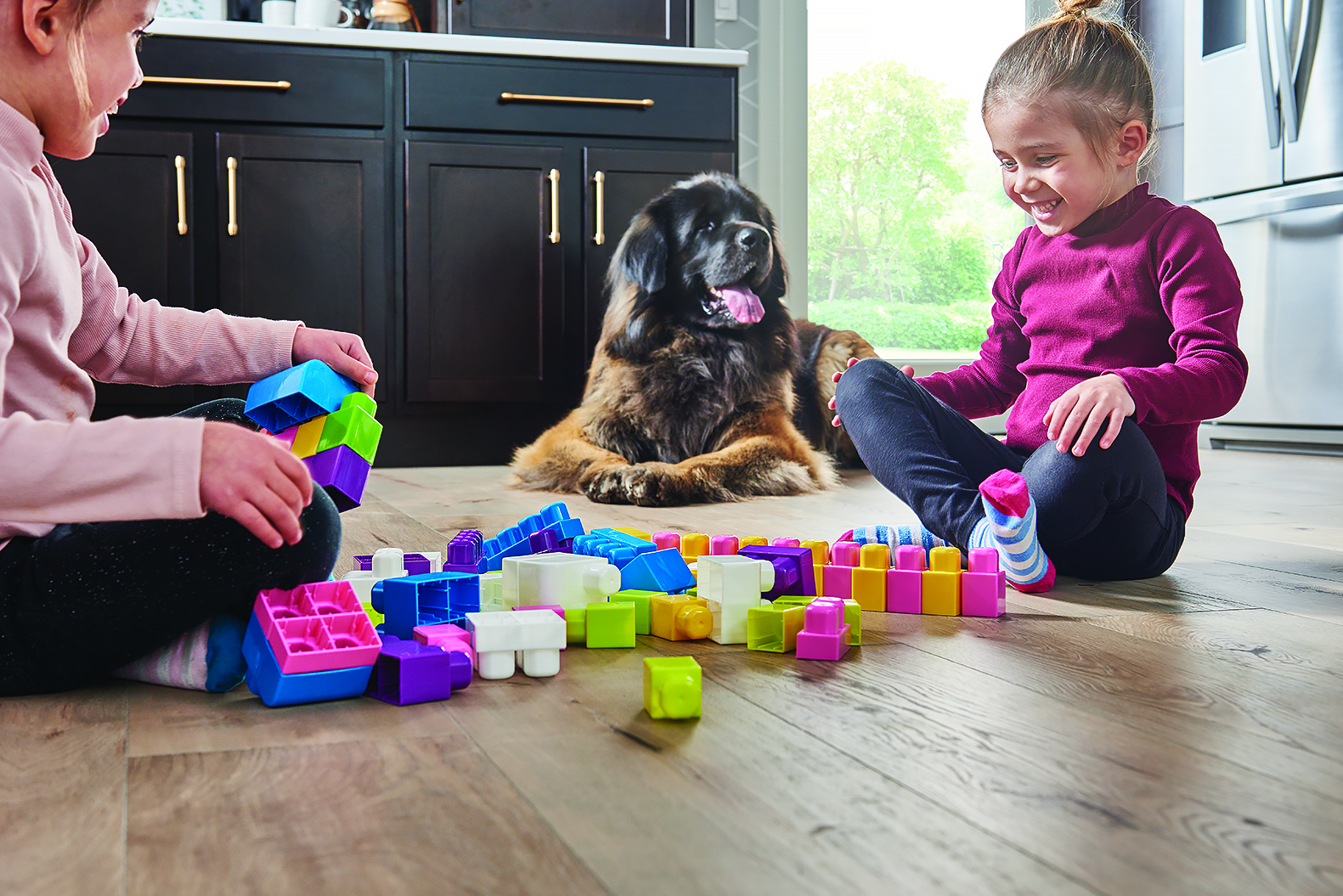
“When Tarkett Home discusses how we want our floors to perform, pets are always part of the conversation,” says Katie Szabo, director of product management for hard surfaces. “Homeowners want a floor that can keep up with accidents, zoomies at top speed and endless amounts of playtime.”
At retail, this lifestyle orientation is reshaping how shoppers engage with flooring displays. Jones says consumers are increasingly entering showrooms with pet performance already in mind.
“Today, many shoppers walk into the store already thinking about how their flooring will perform with pets,” she notes. “At the same time, retail sales associates still play an important role in uncovering those needs during the sales process.”
This dynamic creates opportunities for retailers to differentiate themselves through targeted merchandising, product demonstrations and storytelling that links technical features to everyday living.
SOFT SURFACE’S RENEWED RELEVANCE
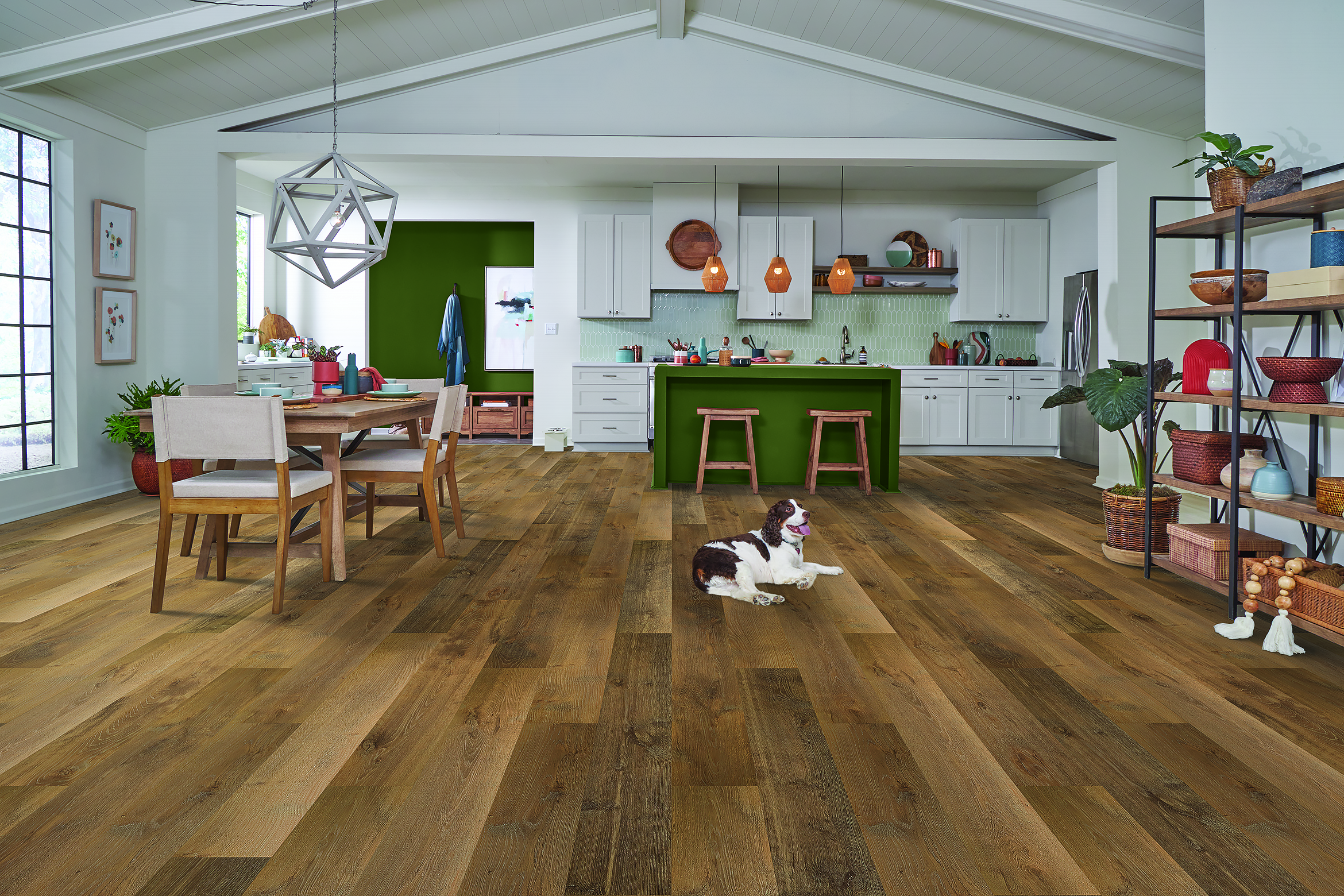
Although hard surface categories continue to dominate overall growth, manufacturers say the pet trend is creating renewed opportunities for carpet in specific areas of the home.
Jones notes that comfort and traction remain important considerations, particularly for aging pets or high-energy animals navigating multi-level homes.
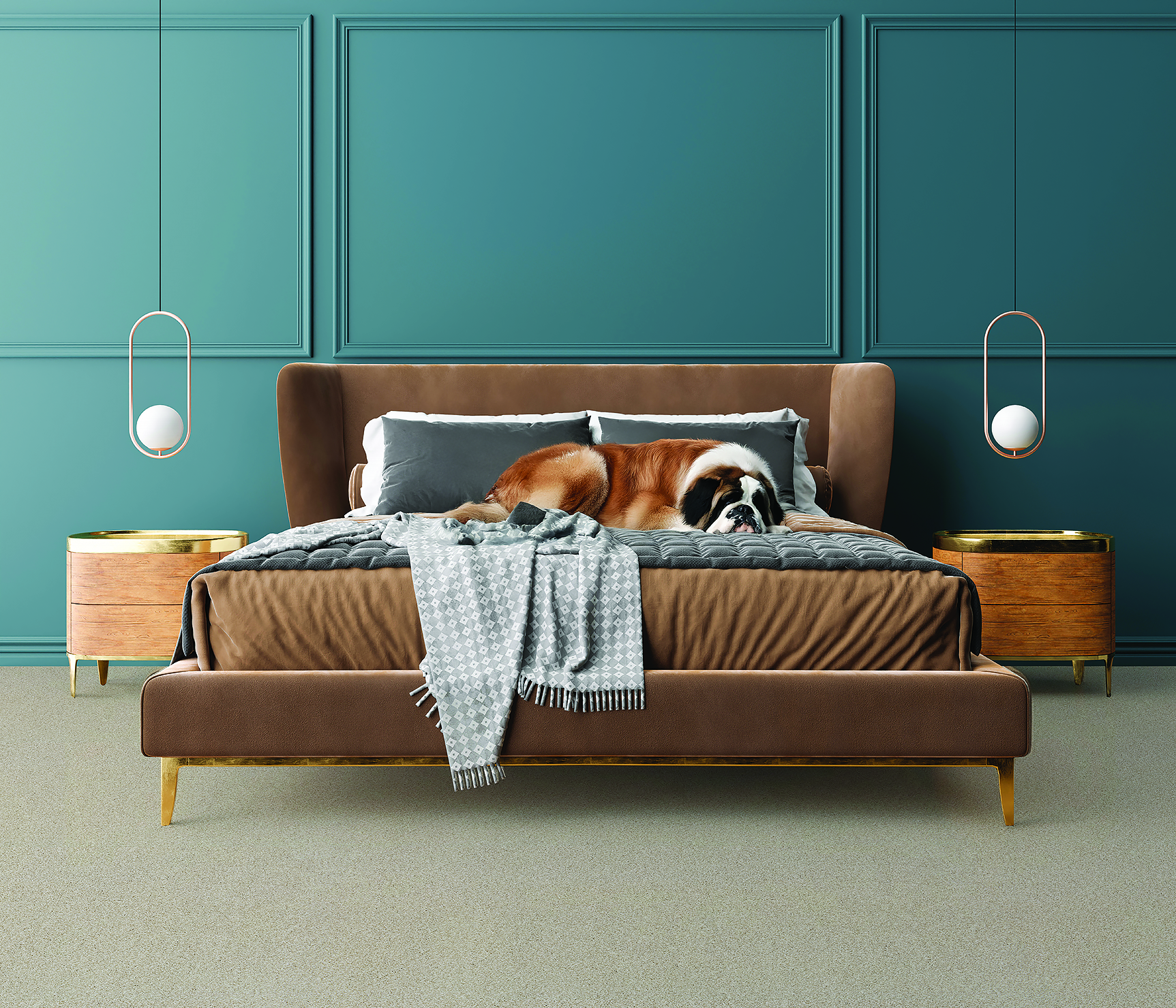
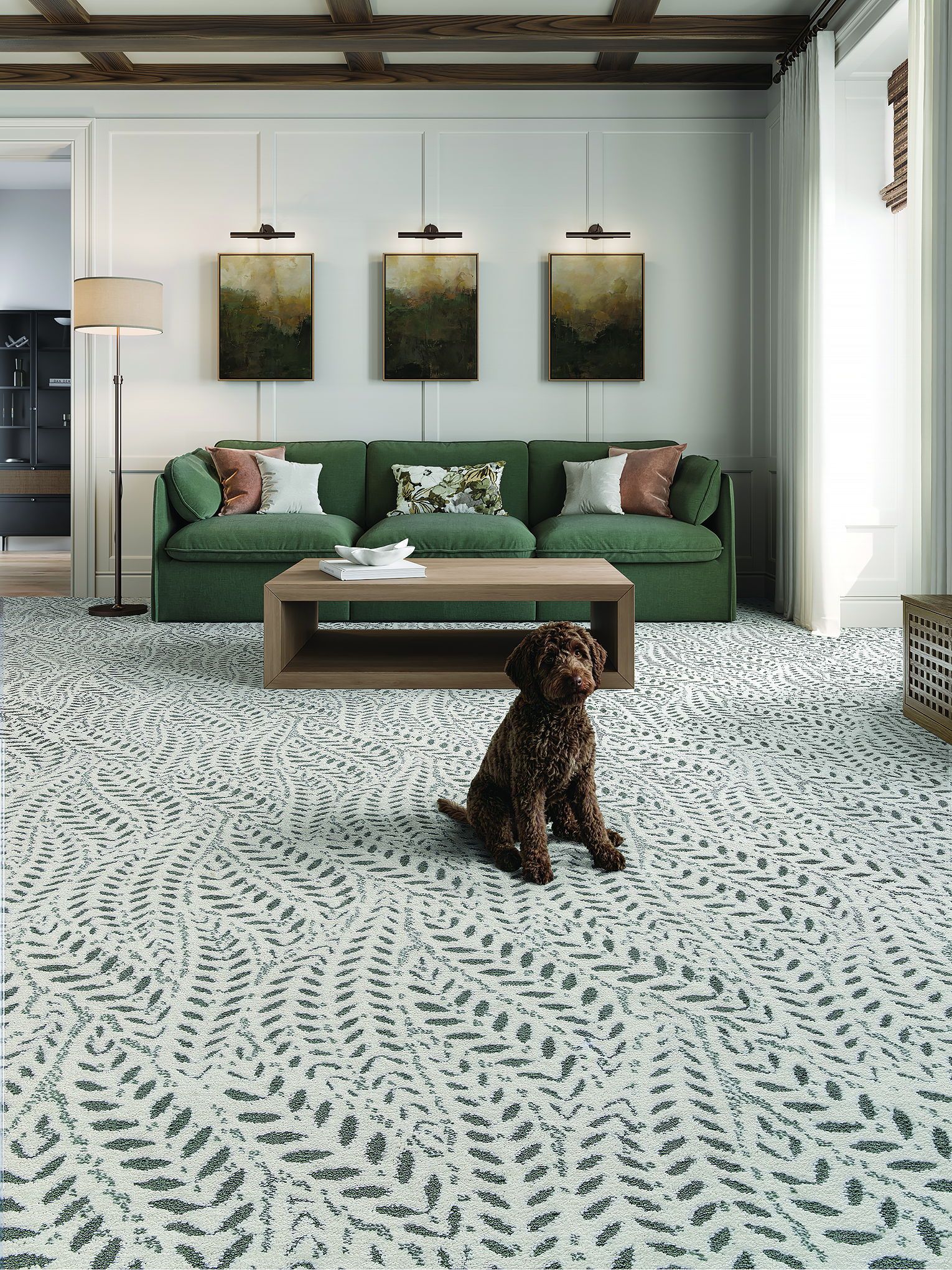
“Carpet continues to play an important role in pet households, particularly in bedrooms, living spaces and other areas where comfort and warmth are priorities,” she says. “Carpet also provides natural traction, which can help pets move around more confidently without slipping.”
Advancements in fiber technology have further strengthened carpet’s performance credentials. Ruppert points to solution-dyed constructions as an example of how innovation has expanded maintenance flexibility.
“With PureColor solution-dyed fiber, the color is inherent to the fiber,” he explains. “This allows homeowners to use a diluted bleach solution on their carpets without fading—a level of performance that was unheard of a decade ago.”
Megan Black, senior product manager for soft surface at Tarkett Home, says modern carpet collections are increasingly designed to balance durability with contemporary aesthetics.
“Pawsh solution-dyed nylon was designed to bring pet-friendly durability and on-trend style together,” she says.
For retailers, these developments support a more holistic selling strategy, pairing resilient surfaces in high-traffic zones with soft surface materials in restorative or acoustically sensitive spaces.
THE RISE OF SENSORY PERFORMANCE
Beyond traditional performance metrics, manufacturers are observing growing consumer interest in sensory factors such as traction, acoustic softness and underfoot comfort.
Ruppert describes this shift as a new frontier in flooring evaluation.
“In 2026, we are seeing ‘sensory performance’ become a top-tier deciding factor,” he says, noting that textured surfaces can improve grip for pets while carpet products help reduce noise transmission in multi-story homes.
Tucker agrees that safety considerations are becoming increasingly prominent as pets live longer and remain active later in life.
“Traction is a big one, since slippery floors can lead to injuries,” she explains. “Pet owners are thinking more holistically to create safer and more comfortable spaces for their whole family.”
These considerations reflect a broader trend toward wellness-driven design, in which flooring selection is influenced not only by visual appeal or durability but also by how materials contribute to the physical and emotional comfort of both human and animal occupants.
LOOKING AHEAD
With pet ownership expected to remain strong and younger generations continuing to prioritize animal companionship, industry leaders anticipate that pet-related performance needs will shape flooring innovation for years to come.
Jones believes whole-home performance solutions will become increasingly important as consumers seek consistency across multiple surfaces.
“We expect that whole-home approach to become even more important as consumers look for consistent performance throughout the home,” she says.
Ultimately, the rise of pet households reflects a broader shift in how residential environments are designed and used. Flooring is no longer simply a decorative finish—it is a strategic element supporting the rhythms of daily life.
As manufacturers refine technologies and retailers adapt merchandising strategies, the industry’s challenge will be to translate technical innovation into relatable benefits that resonate with today’s pet-centric consumers. For many homeowners, the goal is straightforward: flooring that allows them to enjoy their homes without compromise, whether they are entertaining guests, raising children or watching a beloved dog race across the living room floor.
And as the pet economy continues to expand, that expectation is poised to become not just a trend, but a defining characteristic of residential flooring demand.

Join Our Newsletter
Get the latest flooring industry news delivered weekly.